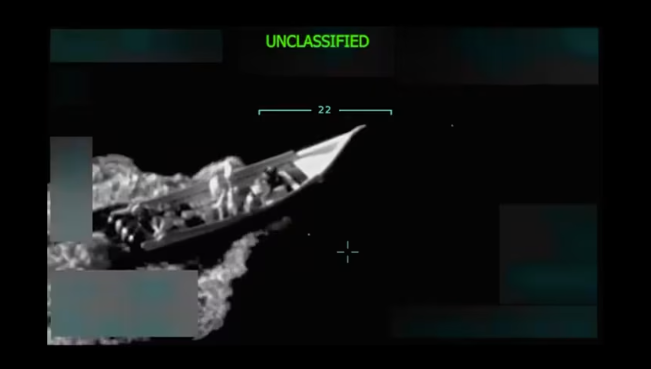


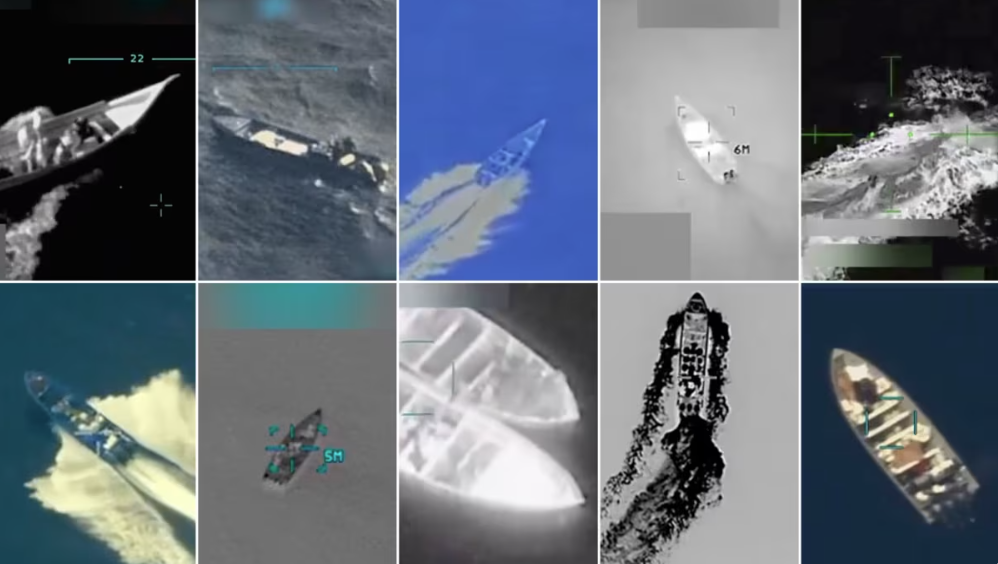
(Pete Hegseth/X/Donald Trump/Truth Social)
The US military has killed 87 people in strikes that have destroyed 23 boats as part of a campaign that Washington says is aimed at curtailing the flow of drugs into the United States. There had been three survivors of those strikes, two of whom were briefly detained by the US Navy before being returned to their home countries. The other is presumed dead after a search by the Mexican Navy.
The Trump administration has told Congress that the US is now in an “armed conflict” against drug cartels beginning with its first strike on September 2, labeling those killed “unlawful combatants” and claiming the ability to engage in lethal strikes without judicial review due to a classified Justice Department finding.
Some members of Congress as well as human rights groups have questioned that finding and argued that potential drug traffickers should face prosecution, as had been the policy of interdiction carried out by the US before President Donald Trump took office.
The Trump administration has also not provided public evidence of the presence of narcotics on the boats struck, nor their affiliation with drug cartels.
Military officials have said that no US service members have been harmed in the strikes.
Here is the timeline of the attacks:
Tracking US strikes on alleged drug boats
There have been at least 23 strikes on boats in the Caribbean Sea and Pacific Ocean since September 2025, resulting in 87 reported deaths.
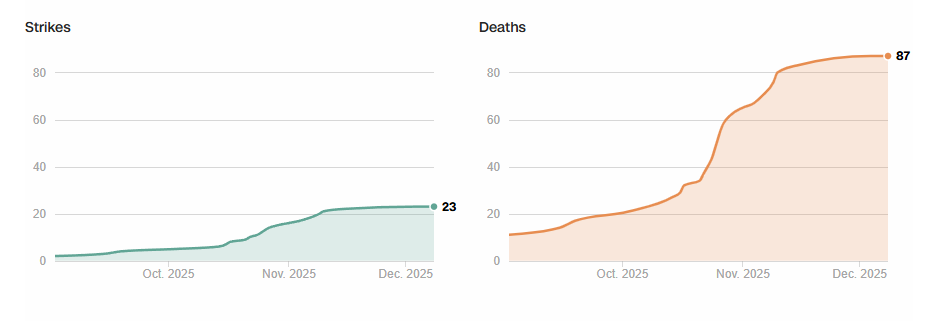
Sources: Department of Defense, White House announcements
September 2, first attack
The first strike on a vessel in the Caribbean took place on September 2.
Trump announced the offensive on his social media accounts and said that under his orders, US forces “conducted a kinetic strike against positively identified Tren de Aragua Narcoterrorists in the SOUTHCOM area of responsibility.”
“TDA is a designated Foreign Terrorist Organization, operating under the control of Nicolas Maduro, responsible for mass murder, drug trafficking, sex trafficking, and acts of violence and terror across the United States and Western Hemisphere,” Trump wrote on Truth Social.
“Let this serve as notice to anybody even thinking about bringing drugs into the United States of America. BEWARE!” he added.
The US military also carried out a follow-up strike on that suspected drug vessel after the initial attack did not kill everyone on board, sources familiar with the matter told CNN. Trump administration officials had not publicly disclosed the second strike.
While the first strike appeared to disable the boat and cause deaths, the military assessed there were survivors, according to the sources. The second attack killed the remaining crew on board, bringing the total death toll to 11 and sinking the ship.
CNN also reported that the boat appeared to have turned around before it was struck.
Before the operation, Secretary of Defense Pete Hegseth ordered the military to ensure the strike killed everyone on board, but it’s not clear whether he knew there were survivors before the second strike, one of the sources said.
People briefed on the “double-tap” strike said they were concerned that it could violate the law of armed conflict, which prohibits the execution of an enemy combatant who is “hors de combat,” or taken out of the fight due to injury or surrender.
While there would be one other instance the following month when crew members survived a strike on an alleged drug boat, in that case the US Navy detained the two survivors and returned them to their home countries.
CNN reported that Defense Department officials have not, during briefings to members of Congress, presented conclusive evidence that the targets of the attack were members of Tren de Aragua, and that those briefed said military officials could not determine the intended destination of the boat with certainty.
September 15
Less than two weeks later, the US military carried out a second strike against a vessel in international waters, killing three.
Trump said the vessel was allegedly “transporting illegal narcotics” from Venezuela.
“These extremely violent drug trafficking cartels POSE A THREAT to US National Security, Foreign Policy, and vital U.S. Interests,” he added.
The strike came amid rising tensions with that country, as the United States deployed military assets to the region.
Venezuelan President Nicolas Maduro has described the strikes on boats as “serial executions” and called on the UN to investigate, while saying that the US is seeking regime change. Venezuela’s defense minister, Vladimir Padrino, said it amounts to “an undeclared war,” while the foreign ministry denounced Washington’s “military threat.”
At the time, Hegseth and Secretary of State Marco Rubio said they expected more activity in the Caribbean in an effort to reduce drug traffic into the US.
September 19
Four days later, Trump announced another lethal military strike on a suspected drug trafficking vessel that he said was affiliated with a designated terrorist organization.
“Intelligence confirmed the vessel was trafficking illicit narcotics, and was transiting along a known narcotrafficking passage enroute to poison Americans,” Trump posted on Truth Social alongside a video of the operation.
Three people were killed in the strike.
October 3
Hegseth announced that the US military had carried out a fourth strike in which four people died.
The attack took place in international waters just off the coast of Venezuela, Hegseth wrote in a post on social media.
He did not say which alleged terrorist organization the boat was linked to, but added that “Our intelligence, without a doubt, confirmed that this vessel was trafficking narcotics, the people onboard were narco-terrorists, and they were operating on a known narco-trafficking transit route.”
October 14
Six people died in the fifth US strike on a vessel, this boat described by officials as off the Venezuelan coast.
Once again, Trump said the vessel was “affiliated with a Designated Terrorist Organization,” but he did not name a specific group or provide evidence of the boats activities.
In a letter to Congress in early October, the Pentagon said Trump had determined that the United States is in an “armed conflict” with the drug cartels his administration designated as terrorist organizations, and that cartel traffickers are “unlawful combatants.”
October 16
The US carried out a sixth strike on a boat in the Caribbean on October 16.
There were two survivors, one each from Ecuador and Colombia, who were sent back to their home countries after being briefly detained on a US Navy ship.
“At least 25,000 Americans would die if I allowed this submarine to come ashore. The two surviving terrorists are being returned to their Countries of origin, Ecuador and Colombia, for detention and prosecution,” Trump posted on Truth Social.
Jeison Obando Pérez, 34 years old, was identified as the survivor repatriated to Colombia in a post on X by the country’s minister of the interior, Armando Benedetti. Pérez arrived “with brain trauma, sedated, drugged, breathing with a ventilator,” said Benedetti, who added that he had received medical attention.
The survivor from Ecuador, was identified as Andrés Fernando Tufiño Chila, 41 years old, according to a record from the National Police of Ecuador accessed by CNN. He arrived in the country on October 18 and underwent a medical evaluation.
The Office of the Attorney General of Ecuador reported on October 20 that there is no information that Tufiño Chila had committed a crime in Ecuadorian territory. However, US court documents indicate that he was arrested, convicted and imprisoned in 2020 for drug smuggling on the coast of Mexico before being deported.
“No, no… He is not. He is not a criminal,” said Tufiño Chila’s sister, who requested anonymity for security reasons, in statements to CNN from a small coastal town near Guayaquil, Ecuador.
October 17
Hegseth announced that a seventh targeted vessel “transporting substantial amounts of narcotics” was struck and that it was affiliated with a Colombian terrorist organization.
All three crew members on board were killed.
“These cartels are the Al Qaeda of the Western Hemisphere, using violence, murder and terrorism to impose their will, threaten our national security and poison our people,” Hegseth wrote.
“The United States military will treat these organizations like the terrorists they are—they will be hunted, and killed, just like Al Qaeda.”
The attacks sparked public clashes with Colombian President Gustavo Petro, who accused the United States of killing an innocent Colombian citizen during one of its strikes on vessels in the Caribbean. Trump announced he would cancel all US aid and subsidies to the country.
October 21 and 22, first attacks in the Pacific
The US military carried out lethal strikes on two ships in the Pacific, killing everyone on board each vessel, according to Hegseth.
Two people were killed in the eighth strike and three in the ninth.
Hegseth wrote on X that the first vessel targeted in the Pacific was “operated by a Designated Terrorist Organization and conducting narco-trafficking in the Eastern Pacific,” adding, “The vessel was known by our intelligence to be involved in illicit narcotics smuggling.”
The action against vessels in the Pacific appeared to mark an expansion of the US military campaign, as the previous seven attacks were all conducted against ships in the Caribbean Sea.
“Narco-terrorists intending to bring poison to our shores, will find no safe harbor anywhere in our hemisphere,” Hegseth said.
October 24
The tenth attack killed all 6 crew members.
The Defense secretary said the US conducted a nighttime attack on a ship allegedly operated by Tren de Aragua in the Caribbean.
October 27, multiple strikes
Hegseth reported multiple strikes in a single day for the first time, with three missiles hitting four vessels in international waters of the eastern Pacific on Monday, October 27.
He reported that 14 people were killed aboard the vessels “operated by designated terrorist organizations” and that there was one survivor who was not recovered.
“The four vessels were known by our intelligence apparatus, transiting along known narco-trafficking routes, and carrying narcotics,” the Defense Secretary stated.
Hegseth said that the US military had contacted the Mexican government to look for the survivor. The Mexican Navy conducted a search for the person, who is now presumed dead.
October 29
The United States Armed Forces carried out an attack on a vessel in the Pacific Ocean that left four dead, Hegseth reported.
“This vessel, like all the others, was known by our intelligence to be involved in illicit narcotics smuggling, was transiting along a known narco-trafficking route, and carrying narcotics,” the Defense Secretary said in a post on X. He added that US forces suffered no casualties.
November 1
The US military carried out a strike on another vessel in the Caribbean Sea and killed three people on board, according to Hegseth.
“Today, at the direction of President Trump, the Department of War carried out a lethal kinetic strike on another narco-trafficking vessel operated by a Designated Terrorist Organization (DTO) in the Caribbean,” Hegseth announced on X with an unclassified video of the strike. No US forces were harmed in the strike, he noted.
November 4
Hegseth announced the US military struck another vessel “involved in illicit narcotics smuggling” in the eastern Pacific, killing two people on board.
The US Defense secretary again posted an unclassified video of the strike on X, noting that US forces were not harmed and the vessel was struck in international waters.
November 6
The US military conducted a strike against a vessel in the Caribbean, killing three people, according to Hegseth.
“The vessel was trafficking narcotics in the Caribbean and was struck in international waters,” Hegseth said in a post on X, adding that US forces were not harmed in the strike.
November 9
The US military carried out another attack against suspected drug boats on November 9, killing six people in the Eastern Pacific, according to Hegseth.
The military launched two lethal strikes against two separate vessels “operated by designated terrorist organizations,” Hegseth wrote on X, without disclosing which organizations the ships’ crew are believed to have been affiliated with.
“These vessels were known by our intelligence to be associated with illicit narcotics smuggling, were carrying narcotics, and were transiting along a known narco-trafficking transit route in the Eastern Pacific,” Hegseth said.
November 10
The Pentagon conducted another strike on an alleged drug trafficking boat on November 10, a Defense Department official said on November 13.
“The strike occurred in the Caribbean and four narco-terrorists were killed, no survivors,” the official confirmed in a statement to CNN.
November 15
The Pentagon on November 15 conducted another strike on an alleged drug-trafficking boat, US Southern Command announced the following day.
“Intelligence confirmed that the vessel was involved in illicit narcotics smuggling, transiting along a known narco-trafficking route, and carrying narcotics,” Southern Command posted on social media. “Three male narco-terrorists aboard the vessel were killed.”
“The vessel was trafficking narcotics in the Eastern Pacific and was struck in international waters,” per the announcement.
December 4
The US military killed four crew members in another strike on an alleged drug-trafficking boat on December 4, US Southern Command announced. The boat was attacked in the Eastern Pacific.
“Joint Task Force Southern Spear conducted a lethal kinetic strike on a vessel in international waters operated by a Designated Terrorist Organization,” Southern Command wrote in a post on social media.
The post included a 21-second-long video showing the boat being struck. The Pentagon has dubbed the campaign Operation Southern Spear.
Palm Jebel Ali: El Amanecer de una Leyenda. La Estrategia Definitiva de Inversión Inmobiliaria en Dubái para 2025.
Desde mi perspectiva de una década inmerso en las corrientes más profundas del mercado inmobiliario global, he sido testigo de ciclos, euforias y recesos. Pero hay momentos, muy contados, en los que uno siente el inconfundible pulso de una oportunidad que no solo redefine un horizonte, sino que escribe un nuevo capítulo en la historia de la prosperidad. Estamos en 2025, y si hay un nombre que resuena con la fuerza de un eco profético, ese es Palm Jebel Ali.
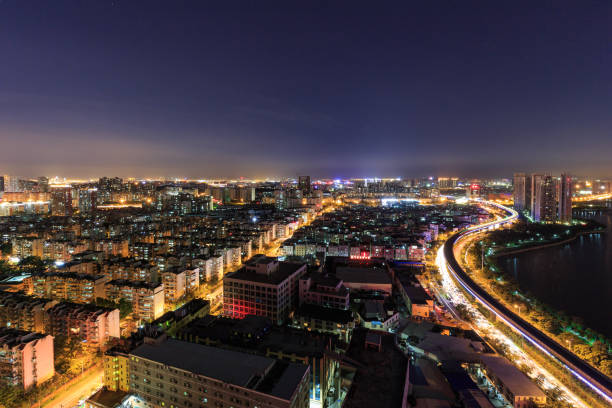
Para quienes hemos seguido de cerca la metamorfosis de Dubái, la mera mención de “La Palma” evoca recuerdos de la explosión de valor y la transformación del paisaje que experimentó Palm Jumeirah. Aquella fue una apuesta audaz, una visión que muchos tildaron de quimera, pero que, con el tiempo, demostró ser una de las inversiones inmobiliarias más lucrativas de la era moderna. Hoy, no estamos ante una mera repetición, sino ante una reinvención, una segunda oportunidad para aquellos visionarios que entienden el arte de la inversión en bienes raíces de lujo. Palm Jebel Ali no es solo un desarrollo; es un paradigma, una manifestación del futuro que Dubái ya está construyendo.
El Despertar de un Gigante Durmiente: Por Qué 2025 es el Momento Culminante
La historia de Palm Jebel Ali es, en sí misma, una lección de resiliencia y estrategia. Concebido inicialmente a principios de los 2000 como una joya más en la corona de Dubái, el proyecto quedó en pausa tras la crisis financiera global de 2008. Durante más de una década, sus contornos sumergidos fueron un recordatorio melancólico de un sueño suspendido. Sin embargo, en Dubái, la palabra “imposible” rara vez se utiliza sin un prefijo de desafío.
El resurgimiento oficial, orquestado y anunciado recientemente, no es un acto de nostalgia, sino una jugada maestra dentro de la Dubai Economic Agenda D33 y, fundamentalmente, del Dubai Urban Master Plan 2040. Estos documentos no son meras aspiraciones; son hojas de ruta estratégicas que delinean el futuro demográfico, económico y turístico de la ciudad. Para 2040, Dubái aspira a duplicar su población y su PIB, consolidándose como una de las tres principales ciudades globales. Y para lograrlo, necesita infraestructuras que no solo alberguen a una población creciente, sino que la atraigan, la retengan y eleven su calidad de vida.
En 2025, el mercado inmobiliario de Dubái ha madurado. Ya no es el salvaje oeste de la inversión desenfrenada. Los inversores de hoy buscan seguridad, sostenibilidad, innovación y, sobre todo, un retorno de inversión propiedades Dubái que esté anclado en fundamentos sólidos. El regreso de Palm Jebel Ali, con una visión que integra la sostenibilidad en su ADN y la tecnología como su columna vertebral, responde directamente a estas nuevas exigencias. Es una declaración audaz sobre el futuro de la vida urbana y la inversión inteligente Dubái, proyectando una visión de la ciudad para las próximas décadas. No es solo un conjunto de propiedades; es un componente crítico en la expansión planificada de la ciudad, un polo de atracción para talento global y capital internacional, lo que eleva su estatus como una inversión en proyectos emblemáticos Dubái de calibre mundial.
El Espejo de Palm Jumeirah: Más Allá de la Escala, Hacia la Sostenibilidad
La sombra de Palm Jumeirah es ineludible y sirve como el mejor de los ejemplos. Quienes invirtieron en ella en sus etapas iniciales vieron cómo su patrimonio se multiplicaba exponencialmente. Pero Palm Jebel Ali no busca simplemente replicar ese éxito; busca superarlo. Y no solo en escala.
Hablar de Palm Jebel Ali es hablar de magnitudes que desafían la imaginación. Duplicará el tamaño de su predecesora, extendiéndose sobre una superficie de 13.4 kilómetros cuadrados y añadiendo la asombrosa cifra de 110 kilómetros de nueva línea de costa a Dubái. Esta expansión no es un mero alarde de ingeniería; es una respuesta estratégica a la creciente demanda de propiedades frente al mar Dubái, un activo cada vez más escaso y valorado a nivel global. Los 110 kilómetros de playas privadas y accesos exclusivos al mar redefinen la exclusividad y la privacidad, elementos que se han vuelto el epítome del lujo en un mundo superpoblado.
Pero la verdadera evolución de esta nueva joya del Golfo reside en su filosofía. A diferencia de su hermana mayor, Palm Jebel Ali ha sido concebida bajo los más estrictos pilares de la sostenibilidad y la tecnología de vanguardia. Estamos en una era donde la conciencia ambiental y la eficiencia energética no son solo modas, sino imperativos. El proyecto integrará vastas zonas verdes, corredores ecológicos que promueven la biodiversidad, y soluciones de “ciudad inteligente” que optimizarán todo, desde el consumo de energía y agua hasta la gestión de residuos y la movilidad interna. Será un ecosistema autosuficiente, un modelo de desarrollos sostenibles Dubái inversión que combinará el máximo lujo con un profundo respeto por el entorno. La vida aquí no será solo opulenta; será consciente, conectada y futurista. La implementación de tecnologías de IA para la gestión urbana, sistemas de energía renovable integrados y una infraestructura digital de última generación aseguran que cada aspecto de la vida residencial y comercial esté optimizado para el confort y la eficiencia, estableciendo un nuevo estándar para la inversión inmobiliaria de lujo Dubái 2025.
Invertir Sobre Plano: La Estrategia Maestra para Maximizar el Retorno
Para el inversor experimentado, la frase “invertir sobre plano” (off-plan property Dubái) en un mercado como el de Dubái es sinónimo de una oportunidad dorada. Significa adquirir una propiedad basándose en los planos, los renders y la reputación inquebrantable de Nakheel –el desarrollador detrás de ambas palmeras–, antes de que la construcción esté completa. Esta estrategia es la que catapultó las fortunas de los primeros inversores de Palm Jumeirah y, con Palm Jebel Ali, la historia parece dispuesta a repetirse, pero con un fundamento de mercado aún más robusto en 2025.
La ventaja es clara y contundente: se accede a precios de lanzamiento significativamente más bajos que los que se alcanzarán una vez que el proyecto esté consolidado y la construcción avance. Históricamente, en Dubái, estos precios experimentan una apreciación sustancial y consistente a medida que el desarrollo toma forma, convirtiendo la visión inicial en un activo tangible y altamente rentable. El mercado de propiedades off-plan Dubái ha demostrado ser un catalizador para la creación de riqueza, y Palm Jebel Ali, por su escala y relevancia estratégica, está destinado a ser su estandarte.
La fase inicial del proyecto ofrece un abanico excepcional de villas de lujo Palm Jebel Ali con acceso directo a la playa, mansiones exclusivas y apartamentos con vistas panorámicas al majestuoso Mar Arábigo. Esta oferta está meticulosamente diseñada para un público inversor global que busca no solo lujo y exclusividad, sino también un alto potencial de crecimiento de capital. Comprar ahora no es solo asegurarse un lugar en el próximo gran ícono de Dubái; es también la oportunidad de seleccionar las ubicaciones más privilegiadas y las tipologías de propiedades más deseables antes de que la demanda masiva agote las opciones. Esta colocación estratégica es crucial para maximizar el retorno de inversión propiedades Dubái, especialmente en un desarrollo que, por su naturaleza y ambición, está configurado para atraer a los inversores más exigentes del mundo. Además, las facilidades de pago a lo largo del periodo de construcción son un incentivo adicional, permitiendo una planificación financiera flexible y una diversificación de patrimonio efectiva.
Vivir en la Nueva Palma: Más Allá de una Residencia, Un Estilo de Vida Completo
Imaginar la vida en Palm Jebel Ali es proyectarse en un destino de primer nivel que, sorprendentemente, es tu hogar. El plan maestro no se limita a residencias espectaculares; es una visión holística de una comunidad integrada. Contempla más de 80 hoteles y resorts de lujo con marcas internacionales de renombre, zonas comerciales que albergarán las boutiques más exclusivas, restaurantes de autor con propuestas gastronómicas de vanguardia y una oferta de ocio inigualable que abarcará desde campos de golf de campeonato hasta puertos deportivos de última generación.
La esencia es crear una comunidad vibrante y autosuficiente donde cada necesidad y deseo esté al alcance de la mano. Los futuros residentes no solo adquirirán una villa o un apartamento de lujo en Dubái; comprarán un estilo de vida completo. Aquí, la playa, los exuberantes parques temáticos y las lagunas cristalinas serán parte de la rutina diaria. La proximidad a centros de bienestar, instalaciones deportivas de élite y espacios culturales de primer orden elimina la necesidad de abandonar la isla para encontrar entretenimiento o servicios de primera clase. Es una apuesta por el bienestar integral y la conveniencia sin precedentes, un modelo de urbanismo del siglo XXI que responde a las prioridades de los expatriados Dubái inversión que buscan una calidad de vida sin igual.

La ubicación estratégica de esta joya es otro de sus grandes atractivos. Situada en el sur de Dubái, Palm Jebel Ali se ancla en el corazón del corredor de crecimiento de la ciudad. Estará a una distancia equitativa de los dos principales aeropuertos: el Aeropuerto Internacional de Dubái (DXB), y el Aeropuerto Internacional Al Maktoum (DWC), cuya expansión masiva lo convertirá en el aeropuerto más grande del mundo para finales de la década. Esta conectividad aérea global es un motor de valor incalculable. Además, su proximidad al puerto de Jebel Ali, uno de los puertos de contenedores más activos del planeta, subraya su relevancia logística y económica. Esta conectividad no solo facilita la vida a sus habitantes, sino que garantiza que la rentabilidad inversión Dubái en Palm Jebel Ali se vea continuamente impulsada por el desarrollo económico y la proyección global de sus alrededores, consolidándola como un epicentro del futuro inmobiliario Dubái.
El Futuro Ya Tiene Forma de Palmera: Dubái No Espera a Nadie
Dubái ha cultivado una reputación bien merecida como un laboratorio del futuro, un lugar donde la audacia y la visión se materializan en proyectos que redefinen lo posible. El regreso y la reinvención de Palm Jebel Ali encarnan a la perfección esta filosofía. No es simplemente un desarrollo inmobiliario; es un golpe estratégico sobre la mesa, una confirmación rotunda de que la visión a largo plazo y la capacidad de ejecución de la ciudad permanecen intactas, desafiando cualquier ciclo económico o expectativa global. Mientras otras metrópolis debaten sobre el futuro, Dubái lo construye a una escala que supera los límites de la imaginación humana, y Palm Jebel Ali es su nueva obra magna, un legado para las generaciones venideras y una pieza central en las estrategias de inversión en bienes raíces Dubái del mañana.
En el vertiginoso mundo de la inversión inmobiliaria, el tiempo es el activo más preciado y, a la vez, el más esquivo. La experiencia de la primera palmera nos dejó una lección inquebrantable: las oportunidades de esta magnitud, aquellas que redefinen mercados y crean riqueza generacional, no suelen presentarse dos veces. Ahora, contra todo pronóstico, el tablero de juego se ha reseteado. La decisión de formar parte de la transformación urbana que representa Palm Jebel Ali es profundamente personal, una elección entre ser espectador o protagonista. Pero el ritmo de esta metrópolis no se detiene; Dubái avanza, dibujando su futuro en las aguas del Golfo.
No deje que esta oportunidad de patrimonio y crecimiento excepcional se escape. La inversión inmobiliaria de lujo Dubái 2025 está esperando, y Palm Jebel Ali es su buque insignia. Contacte hoy mismo a nuestro equipo de expertos para una asesoría personalizada y descubra cómo asegurar su lugar en la próxima leyenda de Dubái.